This walking route takes you past 15 places to see and experience in Copenhagen.
Including Nyhavn, Amalienborg, Langelinie, and The Little Mermaid.
You’ll pass by many well-known Copenhagen landmarks along this route. In our family, this has become a yearly tradition—a classic walk we take each spring in April or May, just when the first truly sunny days appear.
Even after living in Denmark for more than 25 years, it’s still something I look forward to every year. The route is around 7 km, but it feels shorter than it sounds. With a few breaks along the way, it’s an easy and enjoyable walk for both adults and kids. If needed, you can skip Langelinie and shorten the route by about 2 km.
Route overview:

(A) Kongens Nytorv
The walk starts at Kongens Nytorv, where Strøget ends—or begins, depending on your direction. This location once housed the city gate Østerport. When the gate was moved, the area was left empty and used for loading and unloading at the nearby harbor. King Christian V decided it should become a square, establishing it in 1670. At the end of the 17th century, the king allowed those owning land around the square to build, but only with grand houses. That’s why several old palaces still surround Kongens Nytorv today. Currently, the square is home to The Royal Theatre, the French Embassy, and one of the world’s oldest luxury hotels, Hotel d’Angleterre. Nearby is also the large department store Magasin du Nord. The metro station at the square opened in 2019 with the new “Cityringen” metro line. The statue on the square depicts King Christian V, the founder of the location.

Statue of King Christian V at Kongens Nytorv
(B) Nyhavn
Across the square is Nyhavn. The harbor was dug out by Swedish prisoners of war from 1670–73, as an alternative to the old harbor. The oldest house, Nyhavn 9, dates back to 1681. For many years, Nyhavn was one of the city’s roughest neighborhoods, with sailors and “women of pleasure” at the taverns. Where there were sailors, there were tattoo artists; at Nyhavn 17, one of the world’s oldest tattoo studios still exists. In the 1980s, the area was renovated, and today it hosts many restaurants, cafés, and bars. The most famous are probably Nyhavn 17 and Cap Horn.
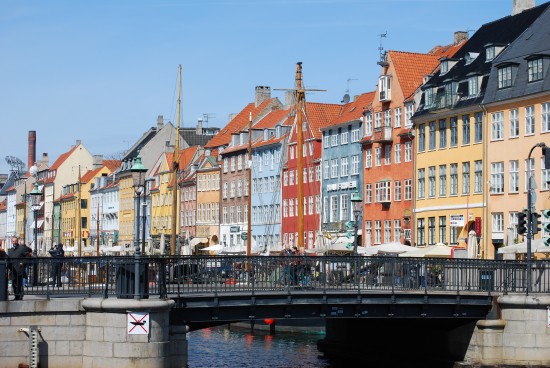
Nyhavn, Copenhagen
(C) The Royal Danish Playhouse
Continue down Nyhavn, past Hotel Nyhavn 71, and you will find Skuespilhuset. This is the theatre house of The Royal Danish Theatre, inaugurated in 2008. Its striking architecture is worth a closer look while walking around the oak-plank pier. Continue around via the harbor to Kvæsthusbroen, Sankt Annæ Plads, and Ofelia Beach
(D) Amaliehaven
Walking along the harbor promenade, you will reach Amaliehaven, a park gifted to the Danish people by a foundation established by one of Denmark’s most successful companies, A.P. Møller-Mærsk. Across the water, you can see the new Opera House, also a gift from “A.P. Møller and Chastine Mc-Kinney Møller Foundation for General Purposes.” The builder was the son of the foundation’s founder, Mærsk Mc-Kinney Møller. As often happens with such projects, there were many long discussions during the construction of both Amaliehaven and the Opera House
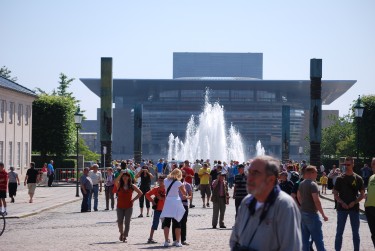
Amaliehaven and the Opera House
(E) Esplanaden
Further along is the headquarters of A.P. Møller-Mærsk, the world’s largest container shipping company, with divisions in over 135 countries and roughly 108,000 employees worldwide. The HQ is often simply referred to as “Esplanaden,” after the street name. Nearby is Nordre Toldbod, which used to be a ferry dock to Poland. Today, the old waiting rooms are a café and restaurant, and outside is the stop for the harbor buses.

Esplanaden – Maersk headquarters
(F) Gefion Fountain & St. Alban’s Church
Next, you’ll see the Gefion Fountain, a large and impressive fountain. Legend tells that the goddess Gefion was allowed to keep as much land as she could plow out of Sweden in one night. She transformed her sons into oxen to plow the land that is now Zealand.
Nearby, you can also spot St. Alban’s English Church, the only Anglican church in Denmark.


(G) The Little Mermaid
Continue along the waterfront until you reach “The Little Mermaid” (Den lille Havfrue). The sculpture depicts the famous fairy tale by H.C. Andersen. Fun fact: it was once flown to Shanghai for Expo 2010. Being one of the most visited spots in Copenhagen, you’ll find tourists of many nationalities gathered here.
(H) Langelinie
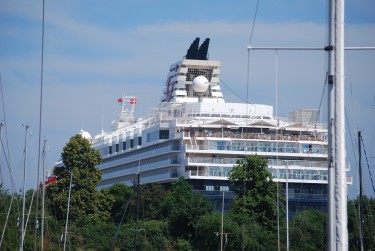
If you have the energy to continue, walk out to Langelinie. In summer, you might see large cruise ships docked here. There are also outlet stores and cafés. At the far end, you’ll find ice cream kiosks—a perfect spot to take a break, enjoy a cone, and watch Malmö or Middelgrundsfortet across the water. Copenhageners love visiting this pier for a casual outing, whether on a motorcycle, in a convertible, or simply for ice cream.

(I) The Old Warehouses
Many of the old warehouses have been demolished, and those that remain have been renovated into offices and luxury apartments. Over the past 30 years, the entire harbor district has been transformed from industrial port to a stylish area of residences and offices.

(J) Kastellet
Head back, cross the street, and walk down the steps to Kastellet. This historic fortress was built from 1662–64 and today serves both as a tourist attraction and workplace for hundreds in the Danish defense. The ramparts are popular for walking or jogging.
(K) Churchill Park & The Danish Resistance Museum
Exiting Kastellet, you’ll enter Churchill Park, named after Winston Churchill. Here you’ll also find the Museum of Danish Resistance, reopened in 2020 as part of the National Museum. The old museum was destroyed by fire in 2013, but most artifacts and archives were saved, and the new museum allows visitors to follow six historical figures and their experiences during Denmark’s occupation from 1940–45 with an audio guide.
(L) Amalienborg
Continuing along Amaliegade, you’ll pass the Esplanade from the other side and reach Amalienborg, the residence of the Danish monarchy. If the flag is flying, the monarch is home. The palace complex consists of four palaces: Frederik VIII’s Palace is the private residence of King Frederik X and Queen Mary, and other parts of the complex accommodate members of the extended royal family or are used for ceremonies and official functions. At 12 every day, you can witness the changing of the Royal Guards, a traditional ceremony of precision and pageantry.


(M) The Marble Church
The final stop is the Marble Church, an impressive building commissioned by Frederick V, officially called Frederik’s Church. Here you can rest your legs after a long but rewarding walk through Copenhagen. Tower viewing tours are available Saturday and Sunday at 1:30 PM.
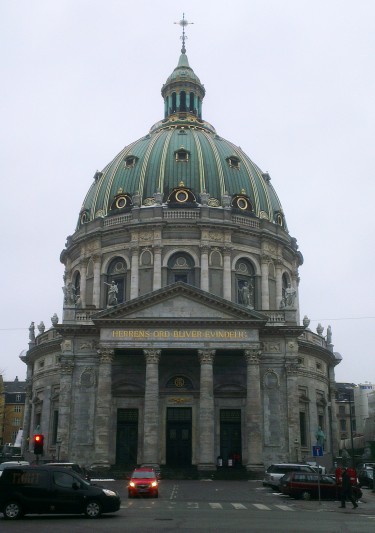
From here, it’s just a few hundred meters back to your starting point at Kongens Nytorv.
If you complete the entire route, you’ll see 15 of Copenhagen’s attractions. Best of all, it costs nothing more than a bit of shoe wear, maybe a lunch, and an ice cream. Save this walk for a sunny day, go at a relaxed pace, and you’ll have a truly enjoyable outing.
Prefer a guided tour? Explore available options here: